Most restaurant owners think they're in the restaurant business.
They're not.
They're in the attention business. Food is simply the product they use to earn it.

Most restaurant owners think they're in the restaurant business.
They're not.
They're in the attention business. Food is simply the product they use to earn it.
That single reframe is the difference between the independents who are compounding traffic every quarter and the ones quietly running a promotion nobody sees. This piece breaks down why the rules changed, what the data now says about how guests actually decide where to eat, and the operating shift the best restaurants have already made.
Twenty years ago, this distinction barely mattered. A good corner, a recognizable sign, a solid menu, and a team that treated guests well — that was the flywheel. Word spread slowly. Competition was local. Marketing was mostly an afterthought reserved for grand openings and the occasional coupon in a mailer.
Today, attention is the scarcest resource in business.
Your potential guest wakes up to hundreds of notifications, dozens of emails, thousands of social posts, text threads, podcasts, YouTube videos, streaming queues, and an endless scroll of content competing for a few seconds of their focus. The average human attention span has fallen from roughly 12 seconds in 2000 to about 8.25 seconds today, with Gen Z hovering closer to 6–8 seconds (Centre for Inquiry Canada).
Then restaurant owners wonder why "good food" isn't enough anymore.
Good food has never been enough. It was simply easier to get people's attention before everyone else was fighting for it.
The way a guest chooses your restaurant now happens almost entirely before they ever walk through the door — and almost entirely on a screen.
Read that last one twice. Your Instagram is more likely to be a guest's first impression than your homepage.
And the payoff is measurable, not theoretical. In 2024, restaurants reported an average 9.9% lift in B2C revenue directly attributed to social strategy — and "social-first" brands, the operators treating content as a core function, posted a 14.1% average lift (Deloitte Digital).
The restaurants winning today understand something many independents still resist. They aren't just producing meals. They're producing stories.
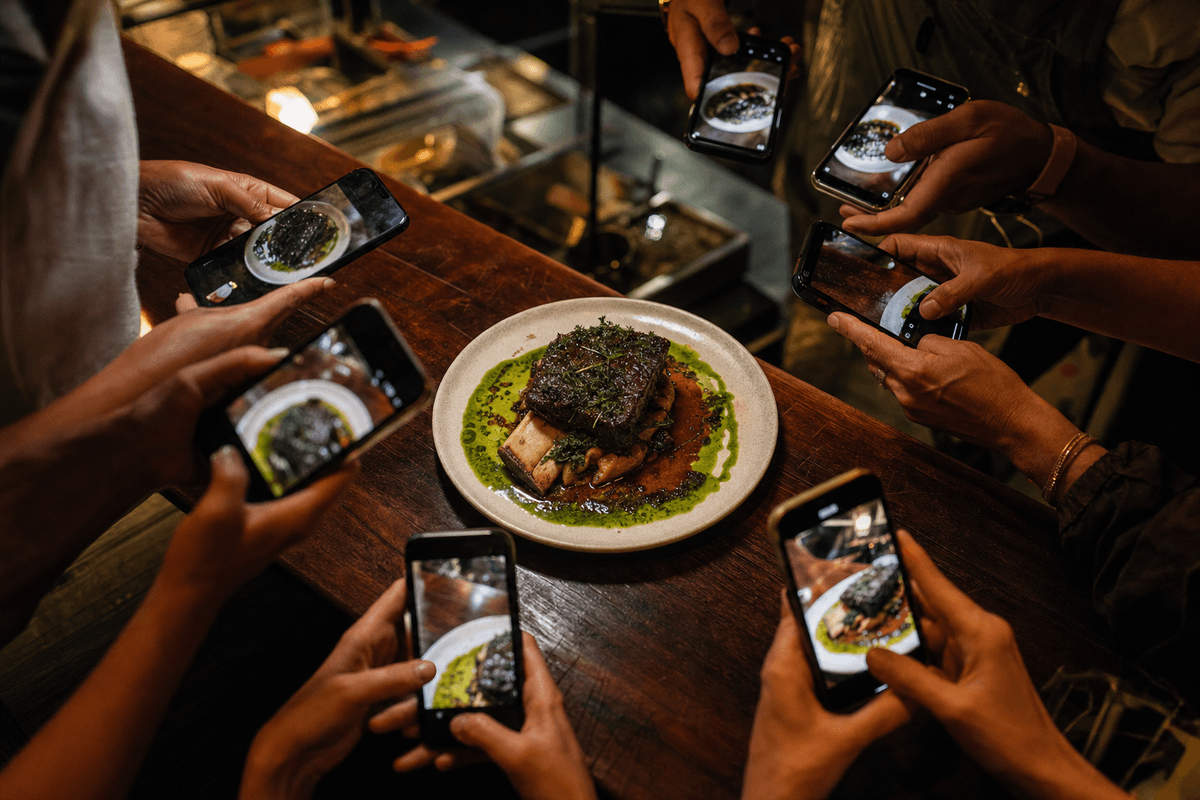
Whether you're publishing or not, you're being published. Guests film your plates. Servers post their shifts. Reviewers screenshot your menu. Your restaurant is generating content 12 hours a day — the only question is whether you're directing that story or letting it happen to you.
The operators pulling ahead have internalized four things:
This is why community management matters more than reach. 93% of social-first restaurant brands rank community management as a high or very-high priority, versus only 63% of less-savvy operators (Deloitte Digital). Replies, DMs, and comments are the new front-of-house.
The most common line we hear from independent operators is that they "don't have time for marketing."
That's like saying you don't have time for oxygen.
Marketing isn't what happens after service. Marketing is what gives people a reason to experience your service in the first place. Every dollar you spent on your buildout, your equipment, your menu R&D, and your team training is stranded capital until someone chooses to walk through the door — and that choice is now made on a phone, in about eight seconds, against every other option in a 10-mile radius.
The math is unforgiving: if 94% of your future guests are deciding online and you're invisible online, you're not competing on food. You're not competing at all.
Here's the framework the top-performing independents in our network are using to reorganize around attention without burning out their teams:
1. Treat content as a station. Assign it. Schedule it. Prep for it. A designated "content station" — one manager or team member per shift responsible for capturing 3–5 pieces of raw content — turns a chaotic, "when we remember" habit into a repeatable line item. It costs you no food and roughly 20 minutes a day.
2. Build a story bank, not a content calendar. Calendars go stale. A living story bank — the origin of each dish, the sourcing behind three ingredients, two staff bios, your five most-asked questions, your three signature moments — gives you 60+ posts you can rotate, remix, and localize indefinitely.
3. Own the direct relationship. 83% of diners are willing to sign up for restaurant marketing programs, but they expect VIP treatment — not just a discount (SevenRooms). Email and SMS lists are the only audiences an algorithm can't take away from you. Build them like you build your wine list.
4. Measure attention, not just covers. Track saves, shares, profile visits, and reservation clicks alongside food cost and labor. Attention metrics are leading indicators; covers are lagging ones. By the time your covers dip, the attention already left.
5. Show up where the decision is made. For guests under 45, that's short-form video — TikTok and Instagram Reels. For Boomers and Gen X, it's still Google reviews and word-of-mouth. A modern restaurant marketing stack has to serve both without picking a side.
The restaurant business hasn't gotten harder because food got harder. It's gotten harder because attention got harder — and most independents are still operating with a 2005 playbook in a 2026 economy.
The operators winning in this environment aren't necessarily the best cooks in their market. They're the ones who realized their real product is a reason to be talked about. Food is how they deliver it.
You are in the attention business. The sooner you build your restaurant around that truth, the sooner your dining room fills itself.
Want more strategic breakdowns like this delivered to your inbox? Subscribe to Food & Beverage Magazine and join 14 million industry readers who lead the conversation. Meet us next at the NRA Show — and see how the industry's top operators are turning attention into revenue.


