

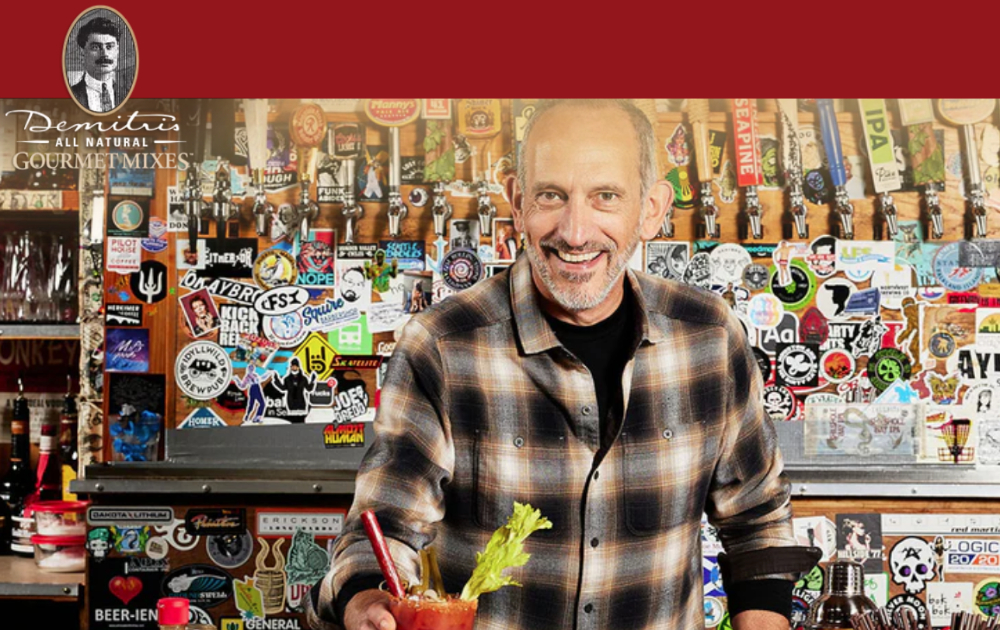
Beverage CEO on labor efficiency, guest experience consistency, and the systems reshaping high-volume service
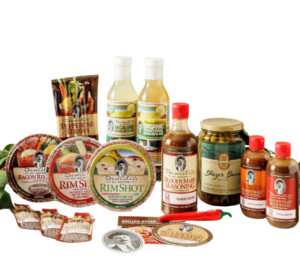
There are very few products in hospitality that quietly become operational infrastructure without most of the industry noticing. Demitri’s Bloody Mary Seasonings is one of them.
For more than three decades, the Seattle-born brand has expanded largely through bartender recommendations, operator referrals, and repeat hospitality adoption rather than splashy consumer campaigns or celebrity partnerships. Today, the company’s seasoning-based Bloody Mary system is used in national restaurant chains, airport bars, casinos, golf clubs, hotels, cruise environments, and independent operators throughout the United States and parts of Canada.
Yet despite the brand’s longevity and strong account retention, Demitri’s occupies an unusual position in the marketplace: a category-defining product with surprisingly low broad-market awareness among the very bartenders and operators who would most benefit from it.
That paradox is precisely what makes the company increasingly relevant in 2026.
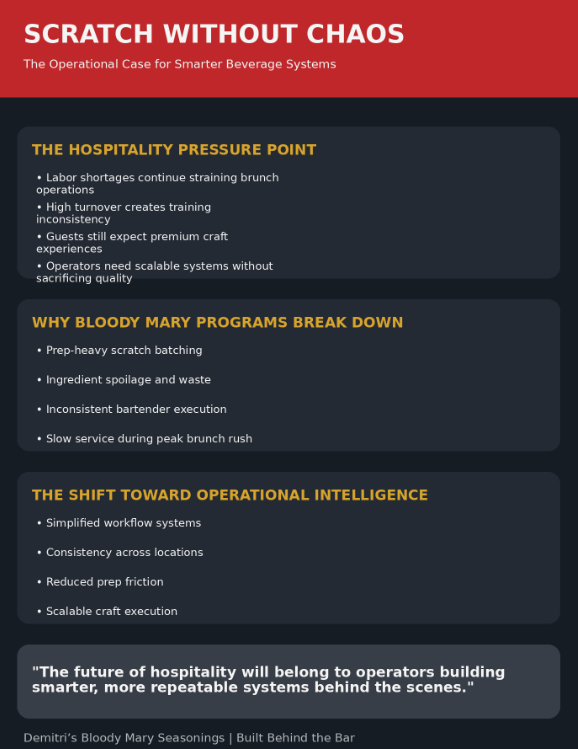
Hospitality operators are navigating one of the most operationally demanding periods the industry has faced in years. Labor pressures remain elevated. Turnover continues to complicate training consistency. Brunch programs have become increasingly important revenue drivers. Meanwhile, guests still expect handcrafted quality and premium experiences even as operators search for systems that reduce waste, streamline execution, and protect margins.
The Bloody Mary sits at the center of that tension.
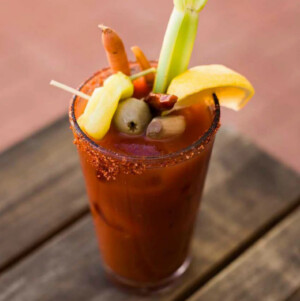
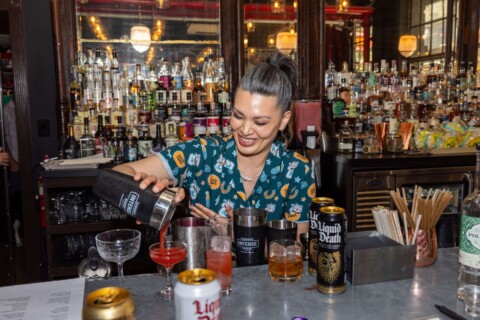
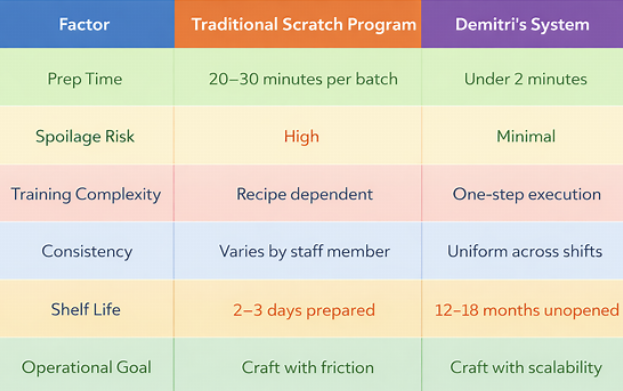
Unlike many cocktails, Bloody Mary programs are notoriously difficult to scale well. Scratch builds require prep time, ingredient management, consistent seasoning ratios, and staff execution that can vary wildly between shifts. During high-volume brunch periods, what should be a profitable signature drink can quickly become an operational bottleneck.
Demitri Pallis understood that problem before the industry fully articulated it.
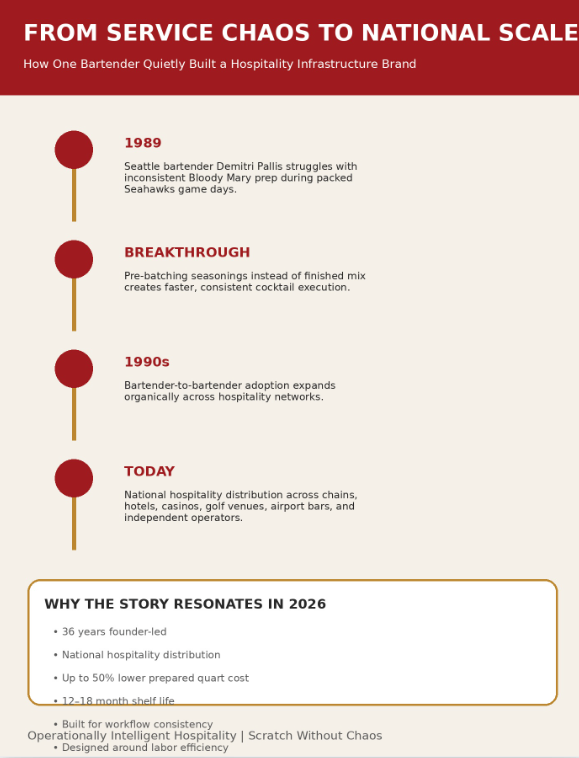
Back in 1989, while bartending at The New Orleans Cafe in Seattle’s Pioneer Square neighborhood near the Seahawks stadium, Pallis became known internally as “the Bloody Mary guy” because he insisted on fresh, handcrafted Bloody Marys. The challenge was not guest demand. The challenge was operational consistency.
If too much scratch mix was prepared, it spoiled. If too little was made, the bar ran out.
One packed Seahawks game day changed everything.
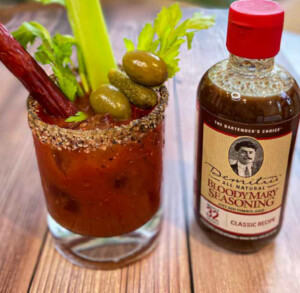 When the mix supply disappeared during a crowded service rush, Bloody Mary sales stopped cold and lower-priced beer sales replaced them. The experience forced Pallis to rethink the production model entirely. Instead of pre-batching finished mix, he began pre-batching the spices and seasonings themselves so bartenders could simply add tomato juice and build consistent drinks instantly during service.
That solution became the foundation for what would evolve into Demitri’s Bloody Mary Seasonings.
Today, the company positions itself around a phrase that increasingly resonates across hospitality operations: “Scratch Without Chaos.”
Based on nearly four decades of front-line industry insight, below Pallis provides a deeper dive into brunch economics, bartender culture, operational consistency and other topics germane to the trade:
Q: You built this business from an operational pain point rather than a traditional entrepreneurial vision. Looking back, why do you think the concept resonated so deeply with bartenders?
DP: Because it solved a problem that bartenders actually lived through every shift. I was not trying to invent a trend. I was trying to stop the chaos. Anybody who has worked a packed brunch shift understands how quickly a Bloody Mary program can fall apart when prep runs behind or recipes vary from bartender to bartender. Once people used the product, they immediately understood the value because it removed friction from service without sacrificing quality.
Q: The hospitality industry often romanticizes scratch cocktail culture. Why do you think operators are starting to rethink that mindset?
DP: Operators are finally looking at the full economics of what scratch really means. Scratch is not free. It comes with labor, spoilage, prep time, training complexity, and inconsistency. The industry accepted that as normal for a long time. But now labor pressure is real. Turnover is real. Operators need systems that protect quality while making service easier. That is where our approach fits.
 Q: You often use the phrase ‘Scratch Without Chaos.’ What does that philosophy represent beyond just Bloody Marys?
DP: It represents a broader hospitality mindset. Guests still want quality. Bartenders still care about craft. But nobody benefits from unnecessary operational disorder. Hospitality teams are under enough pressure already. We built a system that protects the craft while making execution more reliable. That idea applies well beyond cocktails.
Q: How important is consistency in multi-unit hospitality environments today?
DP: It is critical. One of the biggest challenges for multi-unit operators is delivering the same experience across every location and every shift. A signature drink becomes a liability if guests receive different versions every time they order it. Consistency is part of the brand experience. We help operators standardize quality without losing personality.
Q: The company has grown largely through word of mouth rather than aggressive advertising. Why?
DP: Hospitality still runs heavily on trust and peer recommendation. Bartenders talk. Operators talk. Once somebody tastes the product and sees how it performs during service, the conversion tends to happen naturally. We grew bartender to bartender for decades before people started talking about founder stories and operational systems.
Q: What do you think most operators misunderstand about Bloody Mary profitability?
DP: They usually focus only on ingredient cost. They do not always calculate the hidden operational costs behind the program. Prep time matters. Produce spoilage matters. Guest comps matter. Training time matters. The economics become very different when you evaluate the entire workflow instead of only the liquid cost. And, often times, operators leave money on the table because people will pay more for a drink if it delivers a quality experience. Spend $2 more on drink cost to make it better – as with call liquor vs. well, bigger glass, better garnish — and you can charge $4 more for the drink. You just made $2 more per drink!
Q: Why has brunch become such an important category conversation for hospitality groups?
DP: Because brunch is one of the strongest traffic and revenue opportunities many operators have. But brunch is also operationally intense. The Bloody Mary tends to become one of the biggest stress points because guests expect speed and quality simultaneously. The operators that solve that balance tend to perform much better during those shifts.
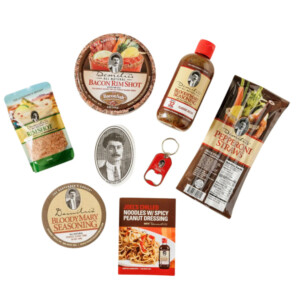 : The product later evolved beyond cocktails into marinades and seasoning applications. Was that intentional?
DP: Not originally. One of my friends used the seasoning as a steak marinade at a tasting party years ago and it was incredible. That opened our eyes to how versatile the flavor profile could be. Today operators use it across food applications as well, which increases the value proposition even further.
Q: How does bartender culture influence your thinking about brand positioning?
DP: We have always viewed bartenders as the core audience, not consumers. Bartenders are the gatekeepers. They decide what gets used behind the bar. We built this product for people working real shifts under pressure. That authenticity matters because bartenders can spot corporate marketing language immediately.
Q: The phrase ‘operational intelligence’ comes up often in hospitality conversations today. How does that concept apply behind the bar?
DP: Operators are becoming much more analytical about workflow. Ten years ago, some inefficiencies were accepted as just part of the business. Today every labor minute matters. Every unnecessary prep step matters. Hospitality groups are asking tougher questions about consistency, scalability, and execution. Beverage systems now need to function almost like operational infrastructure.
Q: Why do you think independent bars remain such an important growth opportunity for the brand?
DP: Independent operators still have incredible influence on hospitality culture. Trends start there. Bartender recommendations start there. The challenge is simply awareness because there are thousands of independent bars across the country. Once operators experience the product in a real service environment, the value becomes obvious very quickly.
Q: What role does speed play in guest satisfaction during brunch service?
DP: Speed affects everything. Guests might wait longer during brunch than dinner because brunch feels more relaxed socially, but they still expect drinks to arrive quickly and consistently. A Bloody Mary that takes too long to execute slows down the entire service rhythm. That creates stress behind the bar and frustration at the table.
 Q: There is often skepticism around anything perceived as a ‘shortcut’ in cocktail culture. How do you navigate that perception?
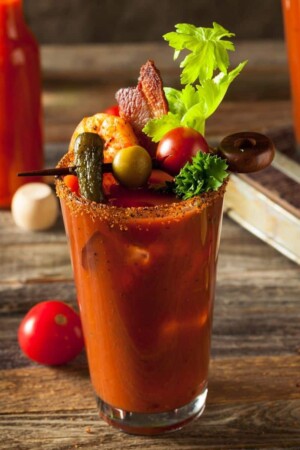
DP: We never positioned the product as a shortcut. We position it as a professional tool. There is a difference. Bartenders still control the garnish, the presentation, the spirit choice, the creativity, and the guest interaction. What we solved was the inconsistency and prep burden behind the seasoning component. Demitri’s offers the exact same experience as building Bloody Marys from scratch. Start with plain TJ, add Worcestershire, lemon, pepper, horseradish and other ingredients. Demitri’s does the same exact thing, but in just one step.
Q: What have you learned from servicing large hospitality groups versus independent operators?
DP: The operational pressures are surprisingly similar. Large groups need scalability and standardization across locations. Independents need reliability with smaller teams and tighter labor constraints. Both ultimately care about consistency, profitability, and guest satisfaction. The scale changes. The core pressures do not.
Q: How important is founder authenticity in today’s hospitality landscape?
DP: I think hospitality people can tell very quickly whether somebody actually understands service or is just selling a story. I still think like a bartender because that is where this started. The product exists because I personally experienced the frustration it solves. That authenticity resonates because operators know it comes from lived experience.
 Q: The company grew quietly for decades without major outside investment or aggressive consumer branding. Do you view that as an advantage today?
DP: In some ways, yes. The brand developed organically through hospitality adoption instead of hype. Operators trusted it because other operators trusted it. That creates a very different foundation than a product built mostly through marketing. We earned credibility shift by shift and account by account.
Q: What advice would you give younger hospitality entrepreneurs trying to build something lasting in food and beverage today?
DP: Focus on solving real problems. The hospitality industry does not need more gimmicks. It needs products and systems that genuinely help operators perform better. Longevity usually comes from usefulness, not novelty.
Q: What does the future look like for hospitality beverage programs?
DP: I think operators are going to continue prioritizing systems that improve consistency, reduce friction, and make teams more effective without compromising guest experience. Hospitality is becoming more operationally intelligent. The brands that help solve real workflow problems are going to matter more and more.
The broader significance of Demitri’s extends beyond Bloody Marys alone. The company represents a growing shift inside hospitality toward operational systems that preserve quality while eliminating unnecessary friction.
In many ways, Demitri Pallis anticipated a conversation the industry is only now beginning to have openly. Operators can no longer afford inefficiency disguised as craftsmanship. They need scalable quality. They need repeatable execution. They need tools that respect bartender culture while improving service realities behind the bar.
That is precisely why Demitri’s continues to resonate.
The product was never built in a test kitchen by marketers chasing trends. It was developed by a bartender trying to survive a packed service shift without disappointing guests or sacrificing standards. Thirty six years later, that practical origin story remains the company’s greatest competitive advantage.
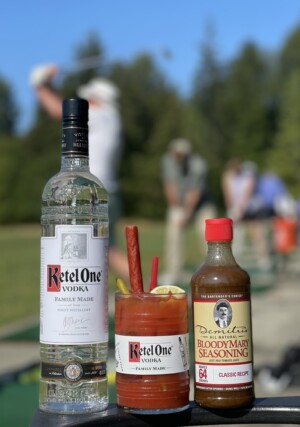 As hospitality groups continue reevaluating labor economics, brunch profitability, workflow consistency, and training simplicity, the Bloody Mary may increasingly serve as a larger metaphor for the future of beverage operations itself.
The bars and hospitality groups that thrive over the next decade will likely not be the ones creating the most operational chaos in pursuit of craft theater. They will be the ones finding smarter ways to deliver exceptional guest experiences consistently, efficiently, and profitably.
For Demitri’s, that future has been hiding in plain sight behind the bar all along.
Beyond the Bloody Mary
At its core, the Demitri’s story is not really about cocktail mixology at all. It is about the evolution of hospitality operations during a period when efficiency, labor management, guest expectations, and profitability increasingly collide.
The modern restaurant and bar business no longer has the luxury of separating craftsmanship from operational performance. Operators are expected to deliver premium guest experiences while simultaneously navigating labor shortages, rising costs, training inconsistency, tighter margins, and elevated consumer expectations for speed and quality.
That is why the broader philosophy behind Demitri’s increasingly resonates beyond the Bloody Mary category itself.
The company represents a larger movement toward operationally intelligent hospitality systems that protect quality while reducing friction. In that sense, “Scratch Without Chaos” functions not merely as a marketing phrase, but as a reflection of where much of the industry appears to be heading.
What makes the brand especially compelling from a trade and business standpoint is the authenticity behind it.
This was not a Silicon Valley disruption story designed in a conference room. It was a bartender trying to survive a packed brunch shift without compromising quality, profitability, or guest experience. The product emerged from service pressure, not trend forecasting. That origin continues to shape how operators perceive the brand today.
There is also something increasingly rare about a founder who spent 36 years refining one operational solution instead of constantly chasing category expansion. In an era where many hospitality products are designed primarily for marketing velocity or investor narratives, Demitri’s grew through practical adoption and long-term account retention. That distinction carries weight inside the hospitality industry, where trust is often earned through repetition, reliability, and peer validation rather than advertising alone.
As brunch culture continues expanding and beverage programs become more strategically important to hospitality profitability, conversations around execution systems, labor efficiency, spoilage reduction, and scalable quality will likely intensify.
The Bloody Mary may seem like a niche category conversation on the surface. In reality, it exposes many of the exact operational tensions facing hospitality more broadly.
How do operators preserve quality while reducing complexity?
How do bars maintain consistency amid turnover?
How do restaurants protect margins without diminishing guest experience?
How do hospitality teams scale craftsmanship across high-volume environments?
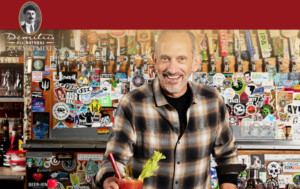 Demitri’s does not claim to solve every operational challenge inside hospitality. But its longevity suggests it identified one particularly important friction point earlier than most.
And for an industry increasingly forced to do more with less while still delivering memorable experiences, that insight may prove more relevant than ever.
The future of hospitality will likely belong not to the businesses creating the most theatrical complexity, but to the operators building the smartest, most repeatable systems behind the scenes.
For 36 years, Demitri Pallis has quietly been making that argument from behind the bar.
~~~~~
As a Food & Beverage Magazine contributor, Merilee Kern, MBA keeps her finger on the pulse of the marketplace in search of new and innovative must-haves and exemplary experiences at all price points, from the affordable to the extreme, with a particular focus on food, beverage, travel, hospitality and luxury lifestyle trends. Her work reaches multi-millions worldwide via broadcast TV (her own shows and others on which she appears) as well as a myriad of print and online publications. Connect with her at www.TheLuxeList.com / Instagram www.Instagram.com/MerileeKern / X www.X.com/MerileeKern / Facebook www.Facebook.com/MerileeKernOfficial / LinkedIN www.LinkedIn.com/in/MerileeKern.
Source:
https://restaurant.org/research-and-media/research/research-reports/state-of-the-industry/