

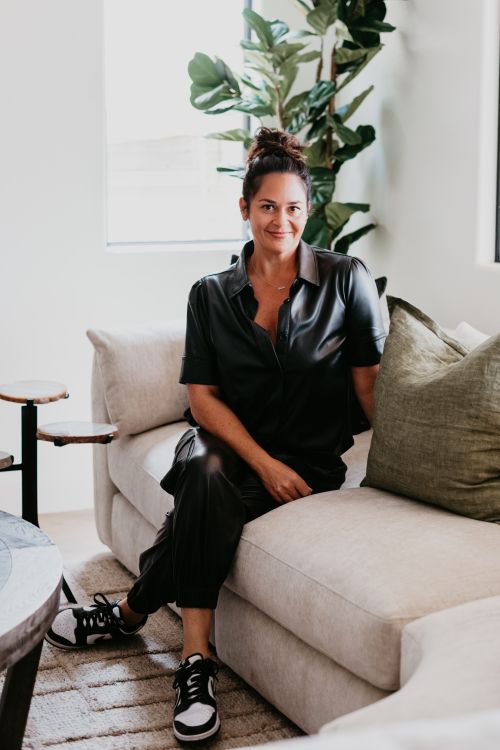
There’s a reason Antonia Lofaso has remained one of the most respected forces in hospitality while so many others have faded into trend cycles. Long before “chef-driven brands” became a marketing formula, Lofaso built a career rooted in instinct, discipline, and an unapologetic commitment to authenticity; One that seamlessly bridges restaurants, television, fashion, entrepreneurship, and motherhood without ever feeling manufactured. Whether leading acclaimed concepts like Scopa Italian Roots, Black Market Liquor Bar, and DAMA or commanding screens on Top Chef and Tournament of Champions, Lofaso has built her empire by refusing to separate personal identity from professional ambition.
What emerges in conversation is not simply a celebrity chef, but a restaurateur deeply protective of hospitality’s emotional core at a moment when the industry itself feels increasingly transactional. Throughout this candid cover-feature interview with Food & Beverage Magazine, Lofaso speaks openly about leadership, burnout, motherhood, intuition, competition, vulnerability, and the future of restaurants in an AI-driven era; All while returning to one central belief: great hospitality is still, above all else, about people.
- You’ve built a career that seamlessly blends chef, entrepreneur, television personality, author, and mother, all while maintaining a fiercely recognizable point of view. In an industry that often pressures chefs to become “brands,” how have you protected the authenticity of Antonia Lofaso while scaling multiple businesses and media platforms?
Lofaso:
I really pay attention to my intuition. I choose projects and work with people that I love and respect. If it doesn’t feel right, I don’t do it.
- Across Scopa Italian Roots, Black Market Liquor Bar, and DAMA, there’s a clear throughline of deeply personal storytelling through food, yet each concept feels entirely distinct. What is your process for creating commercially successful restaurants without losing emotional identity?
Lofaso:
Every restaurant concept comes from a place of deep connection and love for that food. It took me a long time to understand that to really connect with people through food, I needed to share what was most personal to me. People feel it, and then it’s not just about a popular restaurant; it feels like a place that they are connected to.
- You’ve spoken about your food as a reflection of both heritage and evolution, where “cavatelli and carnitas can co-exist.” At a time when diners increasingly crave authenticity, how do you define authenticity in modern American dining without allowing it to become creatively restrictive?
Lofaso:
I don’t try to reinvent the wheel. Good food is good food. Classics are always loved and are timeless. It took me a long time to be okay with not being the most creative, but definitely giving the people what they love
- Few chefs have successfully maintained relevance across both hospitality and television for as long as you have. From Top Chef to Tournament of Champions and beyond, how has television changed the expectations placed on chefs? And, do you think the industry is now demanding entertainers as much as culinarians?
Lofaso:
I think if people chose to be both entertainers and culinarians, that would be wonderful. Even if people chose just one, still wonderful. No matter the choice, it’s about education. Making sure whoever is watching, whether your staff or the public, is educated and mentored the best way you can. Chefs are teachers in the deepest parts of themselves.
- Hospitality has become increasingly difficult to sustain post-pandemic, with operators facing labor shortages, rising food costs, and shifting consumer expectations. As a restaurateur with multiple concepts, what do you believe separates the operators who will thrive over the next decade from those who will disappear?
Lofaso:
This is the hardest / saddest question to answer. I have watched incredible restaurants and operators close post-pandemic, people who love this industry with so much loyalty. That is heartbreaking. I think it’s more important than ever to continue to keep standards high in all hospitality. People are eating out less, and because of that, they have to choose you. So don’t give them any reason not to choose you.
- Your restaurants feel intentionally energetic and culturally layered rather than trend-driven. In an era dominated by “Instagrammable” dining, how do you balance visual appeal with the deeper fundamentals of hospitality: flavor, consistency, service, and emotional connection?
Lofaso:
We build restaurants for the people. “What is going to make the public happy?” I think of a place everyone wants to dine. Is this going to make my 26-year-old daughter come and my 75-year-old father? If the aesthetics and menu make both of them happy, I did my job.
- You’ve expanded beyond restaurants into ventures like Chefletics, redefining chef apparel through a more functional and fashion-forward lens. What gaps did you see in the culinary industry that traditional hospitality companies were overlooking, particularly for women in professional kitchens?
Lofaso:
Chefletics was derived from wanting a chef jacket that was more comfortable for a woman’s body; We have breasts and hips. I was squeezing my broad shoulders into jackets that made me physically uncomfortable. Our jobs are very physically demanding, so I want to make jackets that allow for more mobile movement.
- There’s a growing conversation around burnout in hospitality, especially among chefs balancing leadership, media obligations, and constant public visibility. What has success cost you personally — and how has your definition of success evolved over the years?
Lofaso:
I don’t like the term burnout as if it’s a bad thing. Usually, when people “burnout” it’s because what they are doing or how they are doing it isn’t serving them. Feeling uncomfortable reminds you to adjust what you are doing. Success means many different things. I have had career success, and that feels amazing as an individual. It also meant that I wasn’t the most present mother. Do I regret that? Sometimes. My daughter is so proud of me, and I know she is inspired to be anything she wants, and has an incredible work ethic. Do I wish I were with her more? Everyday. I didn’t have a personal relationship for over a decade because of my work. Is it all hard to balance? Yes, because there’s no such thing as balance. Something or someone is always left behind. It’s the circular movement of time and energy that you can balance. But not all can have your attention at the same time.
- You’ve cultivated a reputation for being intensely competitive while also being deeply respected by your peers. In your opinion, what’s the difference between healthy ambition and ego in the culinary world, and why do some chefs struggle to distinguish the two?
Lofaso:
I believe wanting to win is healthy. It’s not ego-driven. For me, it’s about testing everything I have learned over the past 3 decades. I want to win fairly. I want to see other people win. I believe that how you behave in competition says a lot about who you are as a person and your character. And, let’s just say I’ve been in a lot of therapy sessions.
- Your career has unfolded alongside massive shifts in dining culture; from celebrity-chef worship to experiential dining and creator-driven food media. Looking ahead, what do you believe the next major evolution of hospitality will be, and are restaurants prepared for it?
Lofaso:
I believe we are going to see AI involved. We are already seeing a good amount of automated elements in fast-casual restaurants. I’m excited, intrigued, and also worried about the evolution, but we will see! I only hope the Industry stays as traditional fundamentally as it possibly can.
- As someone formally trained in French technique but heavily influenced by multicultural Los Angeles, how do you think global cities like LA are redefining what “American cuisine” actually means in 2026?
Lofaso:
Having a French technique background is something I’m extremely proud of because my fundamentals in cooking are strong and disciplined. Once you have that, you can go into any cuisine and create. I believe American cooking is eclectic. That is America. I love to see that as the standard. Every culture is represented in the best way through food.
- You’ve remained remarkably consistent in an industry known for volatility. What leadership philosophies have allowed you to maintain long-term partnerships, scale concepts successfully, and build teams that continue growing alongside you?
Lofaso:
I believe being a good leader is about allowing other people to grow and lead with you. Everyone deserves to feel encouraged and mentored. I am nothing without all of our teams in the restaurant, and I go into every situation with that on my mind. You have to deeply care about your teams. What are their goals/aspirations? People want to be a part of something great and productive. If you can create that culture, you make great teams.
- Your audience connects with you because you’ve never appeared overly manufactured, whether on television or in your restaurants. In a media environment increasingly driven by algorithms and curated personas, do you think vulnerability has become a competitive advantage in hospitality leadership?
Lofaso:
I only know one way, and that is to be unapologetically me. I have very little tolerance for inauthenticity. I wear my heart on my sleeve, whether good or bad. My intentions are always honorable, so I hope that comes through. I think people want to see realness. There is great power in transparency and honesty. People sometimes think being vulnerable is a weakness; I think the opposite. If I’m crying, let them see it. If I am angry, let them see it. If I’m humorous, let them see it. I think all the things bring my teams together, and audiences that watch feel connected.
- Many chefs eventually choose between creative fulfillment and operational scalability. You’ve managed to pursue both. When you evaluate a new opportunity today — whether a restaurant, collaboration, television project, or brand partnership — what determines whether it aligns with the legacy you want to build?
Lofaso:
My only criterion for who and where I work is whether it feels right. Maybe my intuition tells me that “this is good”, something for me. I know it sounds hokey sometimes when I say it out loud, but I don’t think we as people put enough emphasis on our gut feelings. If a fast-casual restaurant feels right, go with it. Restaurant in another state? Collaboration on a piece of equipment…. A new chef hire… all of it the same. I don’t go by what’s trending. It has to feel right.
- If you could redesign one aspect of the modern restaurant industry from the ground up — culture, compensation, kitchen hierarchy, media expectations, sustainability, or something else entirely — what would you change first, and why?
Lofaso:
This is the hardest question. My answer didn’t come quickly. I love my industry so much, my first instinct was to be like, “No, it’s perfect!” but it’s not. In order to get teams to work hard, care, and be disciplined doesn’t require aggressive behavior. It requires a deep understanding of excellence. Teaching excellence and discipline can be done in a very caring environment. That is what I wish.